

Esta web está diseñada para ser vista en dispositivos móviles.
Por favor, accede con tu teléfono móvil para disfrutar de los contenidos.

This website is designed to be viewed on mobile devices. Please access it with your mobile phone to enjoy the content.

Diese Website wurde für die Anzeige auf mobilen Geräten konzipiert. Rufen Sie sie daher bitte mit Ihrem Handy auf, um den Inhalt vollständig genießen zu können.

Historic-Artistic Panoramic
Iglesia de
San Antonio de Padua

Introduction

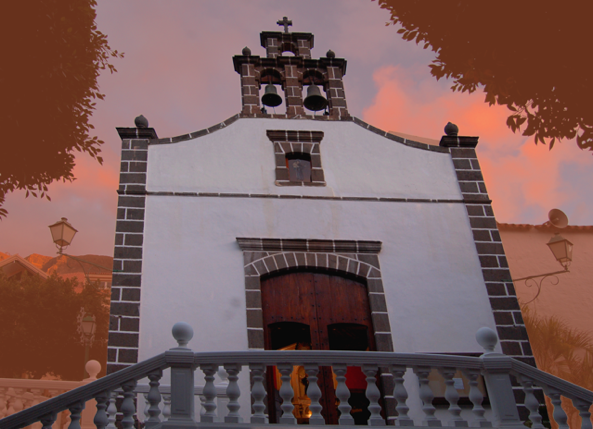
We invite you to enjoy a cultural walk that shows a historical-artistic overview of the “Iglesia de San Antonio de Padua de Mogán” (in English, “Mogan’s Saint Anthony of Padua Church”) .


Its main function is to present basic content that helps us to understand and disseminate knowledge and appreciation of the municipal cultural heritage.
The walk starts at the main door of the church. After reaching this point, we will follow a circular route starting on the right-hand side of the church, travelling from station to station until we have completed the cultural walk.

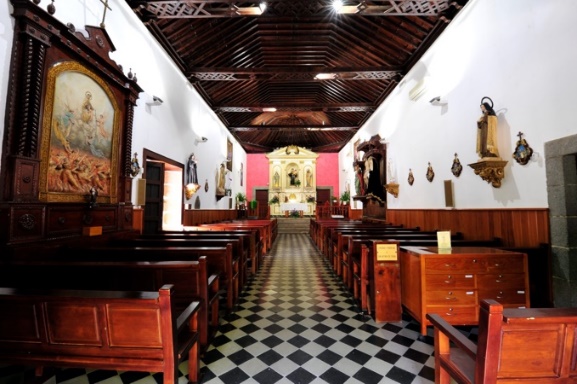
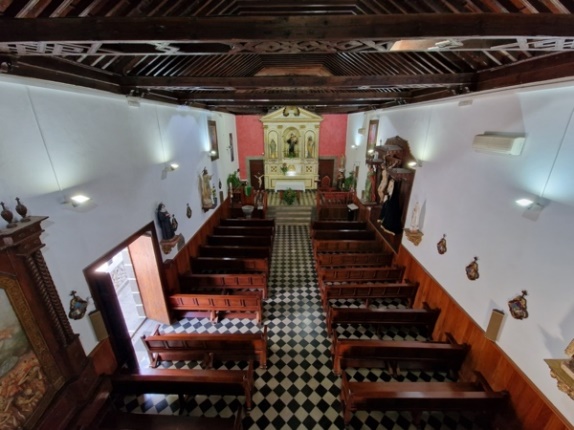
By means of simple numbered exhibitions, the walk informs us about the details and peculiarities of the architecture, the coffered ceiling, altarpieces, paintings and images of sacred art which, as a whole, offer us a historical and artistic vision of the Church of San Antonio de Padua de Mogán.
1. The Parish Church

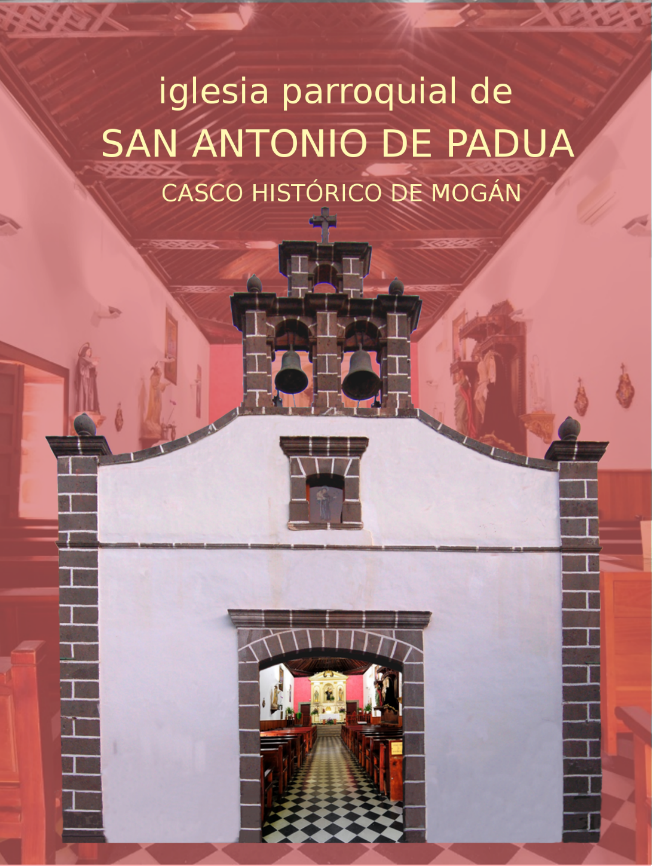
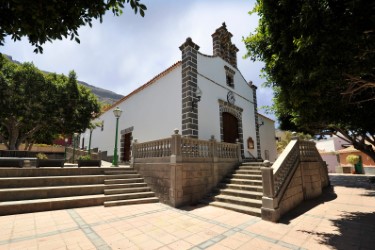
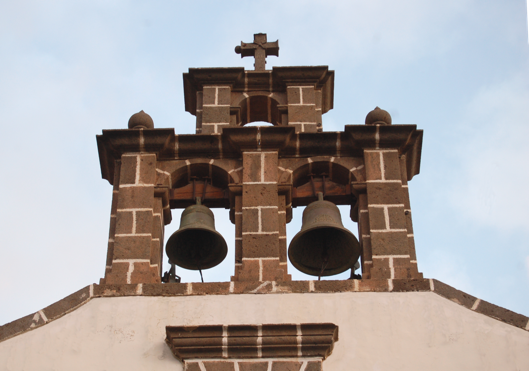
The parish church was built between 1809 and 1814. It was the initiative of a Canary Islander who emigrated to Cuba, Matías Sarmiento, who sent from there the funds with which a large part of the work was financed. 

The project was designed by the sculptor and architect José Luján Pérez. The result was a church with a single nave and masonry walls. It was covered with a wooden coffered ceiling, following the Canarian building tradition of the time. The facade follows the guidelines of the neoclassicism in force at the time, although very simplified.

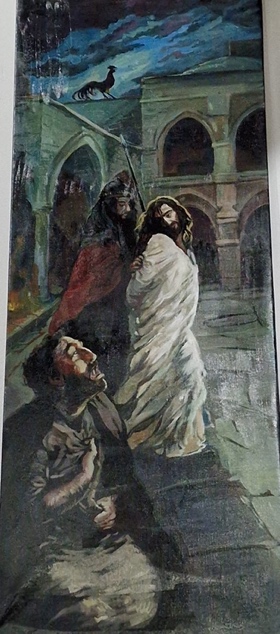
2. Picture of Saint Peter's Repentance after Denying Jesus

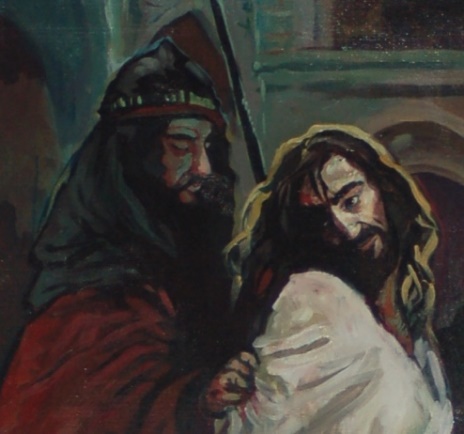
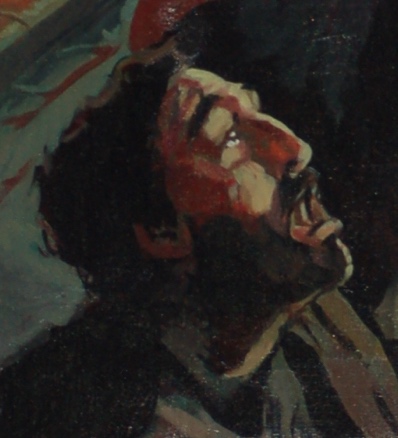
Entering, on our right, there’s a painting depicting the repentance of St. Peter after he had denied Jesus three times, as Jesus had predicted. It is an oil painting on canvas.

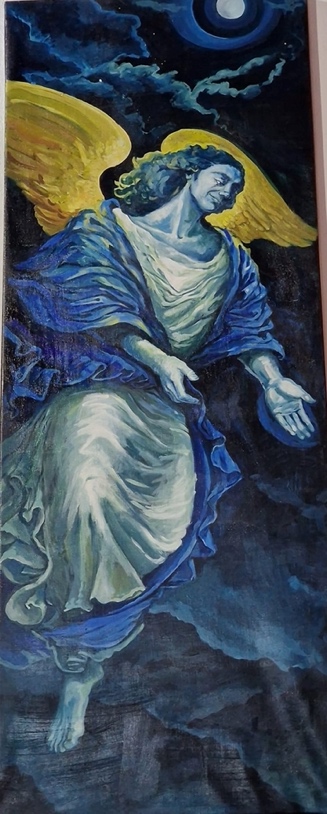
It was painted by Oksana Gaidasheva, a Russian artist who lives in Canada but often spends time in this village. She donated it to this parish a few years ago together with another painting of an angel. This one is at the back of the church.

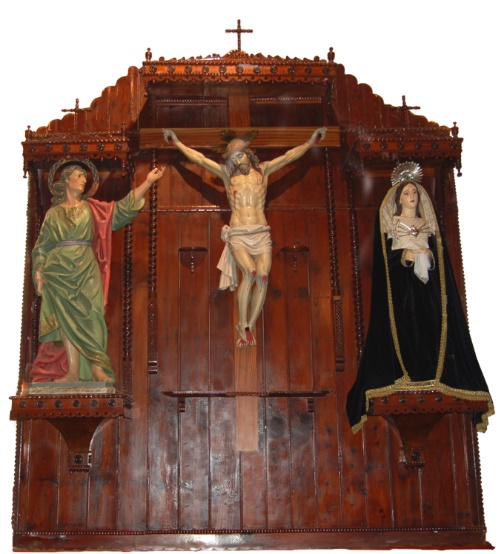
3.1 Calvary Altarpiece

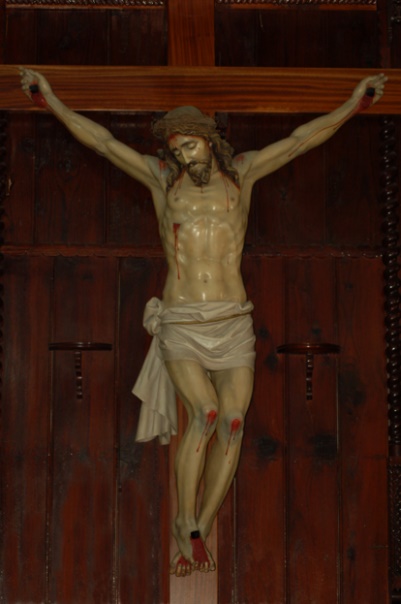
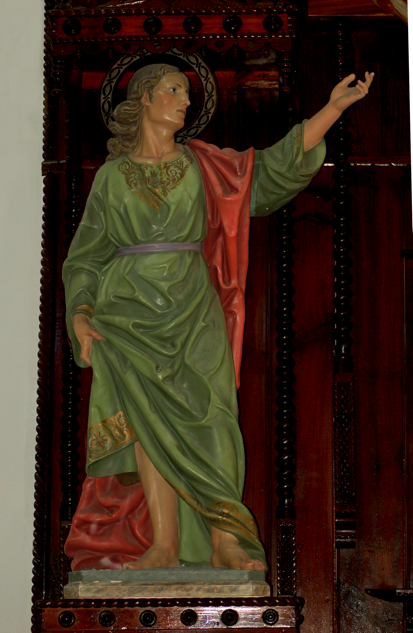
The Calvary altarpiece is made of wood. It is a work of craftsmanship that actually consists of three canopies that cover the images displayed on it. The image of the crucified Christ presides over the central canopy. To its right, Saint John the Evangelist, and to its left, Our Lady of Sorrows.

It must have been built in the second half of the 20th century, as it is still not mentioned in the 1933 inventory. We do not know who designed it.

3.2 Our Lady of Sorrows

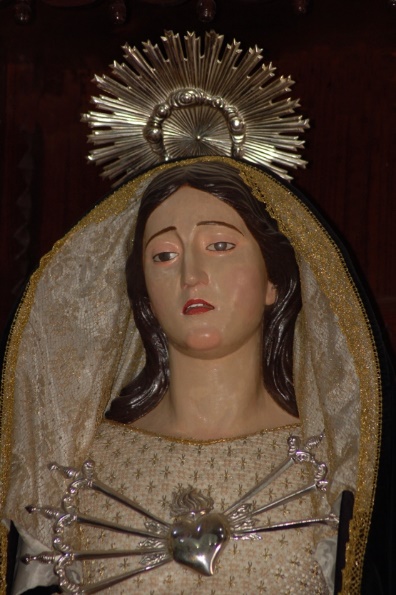
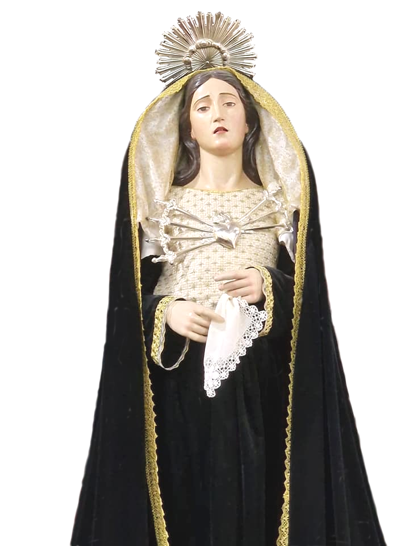
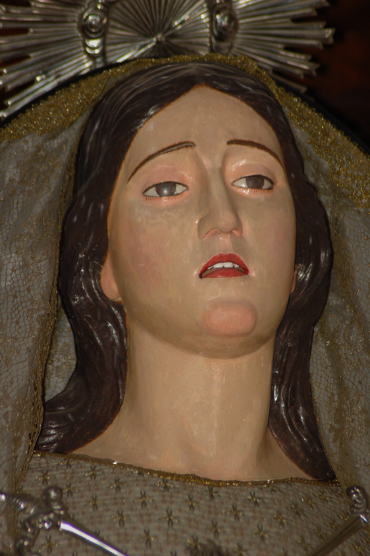
Of the three images on display in the Calvary altarpiece, we would especially like to highlight that of Nuestra Señora de los Dolores (Our Lady of Sorrows). This is of interest because it is a polychrome wooden work, suitable for clothing. Its stylistic features suggest that it is the work of a 19th century image-maker.

It tries to imitate the “Dolorosas” of the great Canary Islander image-maker José Luján Pérez, although in a lesser tone. On its chest is a heart flanked by seven daggers. It refers to seven particularly painful moments in Mary’s life.

4. Immaculate
Heart of Mary

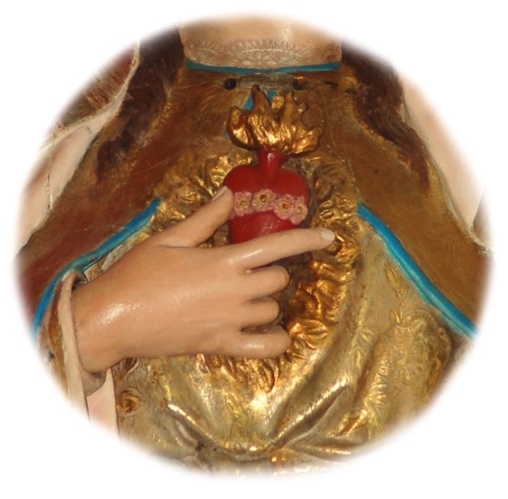
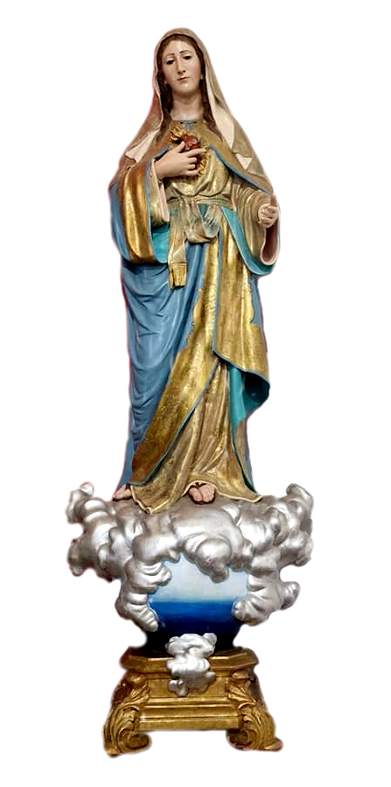
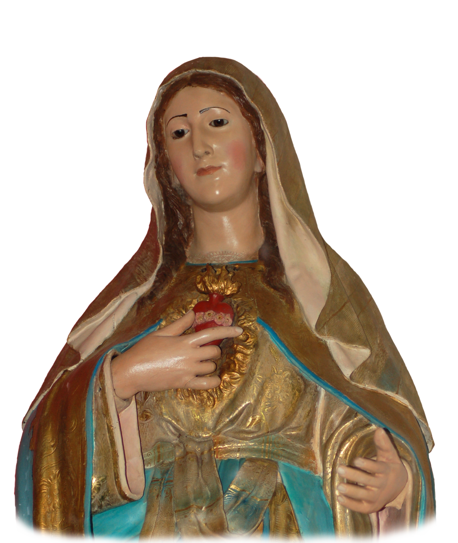
The image of the Immaculate Heart of Mary is made of polychromed wood with gilded vestments. It depicts the Virgin Mary on the globe covered with clouds. With her right hand she shows her heart, symbol of her love for God and mankind. The image has all the appearance of those made in Valencian religious art workshops, such as, for example, the design of the silver cloud that invades part of the base that supports the whole.

It is first recorded in the inventory of 1933. It is therefore possible that it was acquired in the 1920s. It suffered some damage in a small fire, but has been restored and has been placed once again for the veneration of the faithful.

5.1 Major Retable
General Description

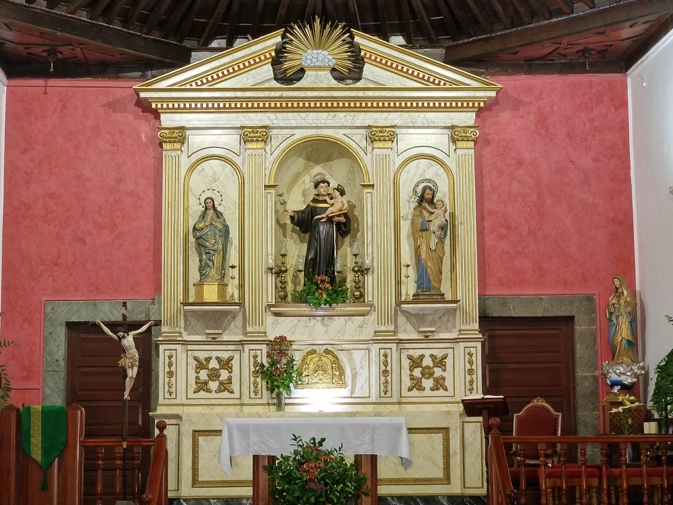
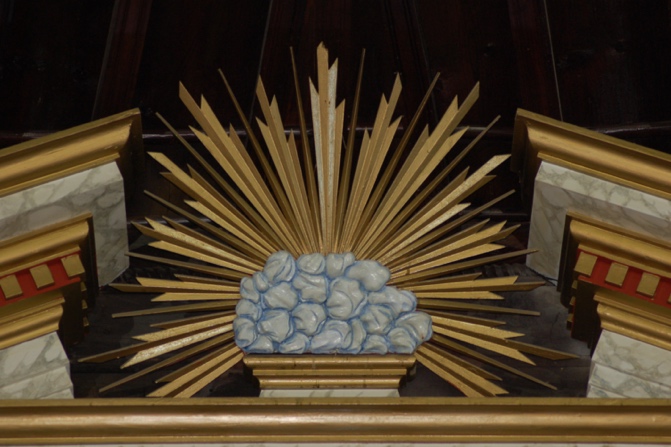
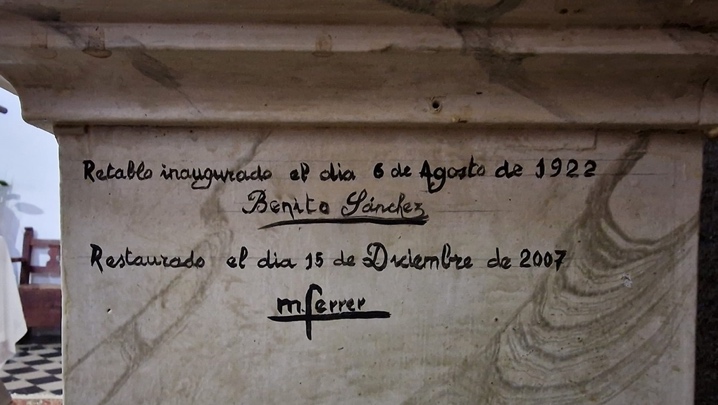
It follows the guidelines of the neoclassical style, although it is rather late in time, as it was built around 1922. It is made of wood and polychrome imitating marble. It is crowned by a figure of clouds from which rays of light emanate, alluding to the Divinity. The altarpiece was paid for by the local resident Marcelino Marrero Quesada, and was inaugurated on 6th August 1922.

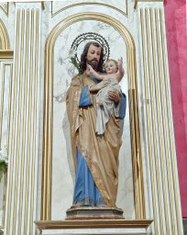
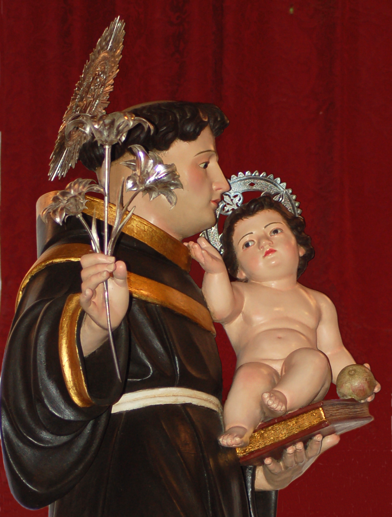
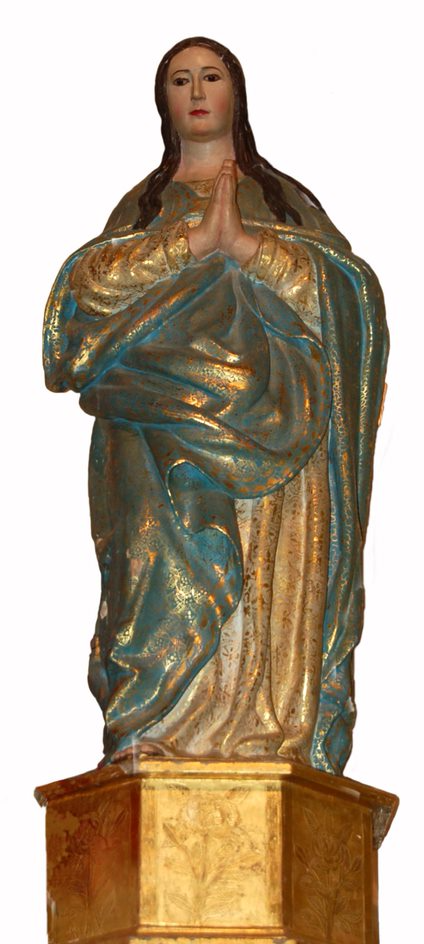
There are two interesting images on the altarpiece: the patron saint, Saint Anthony of Padua, who presides over the altarpiece, and to his right, the Immaculate Conception. The one we see to our right represents Saint Joseph, which is a serial image, made in plaster, acquired in 1916.
5.2 Saint Anthony
of Padua

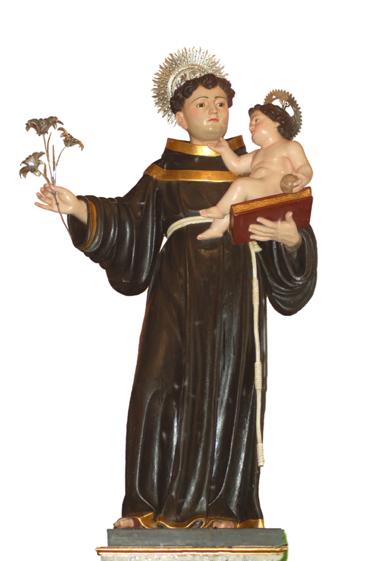
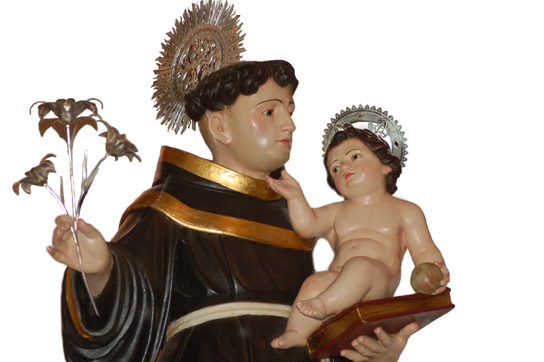
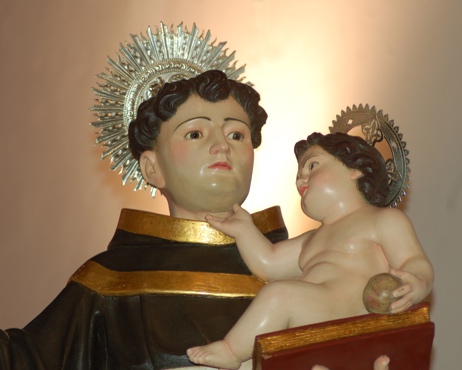
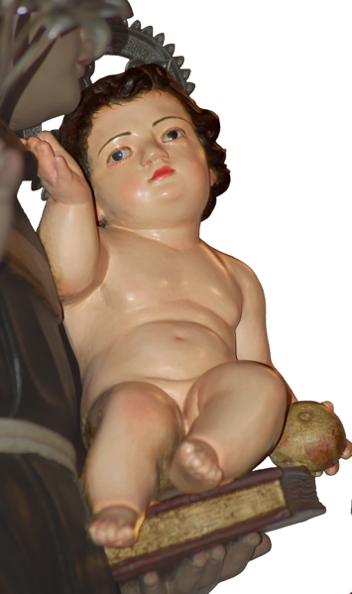
The image of St. Anthony of Padua is a sculpture made of polychrome wood. It represents the saint holding Jesus as a child in his left hand. In his right hand he holds a bouquet of lilies, a symbol of purity. It was made in 1814, paid for by the archdeacon of the cathedral of the Canary Islands, Antonio María de Lugo. The author is not known.

However, both the dates on which it was made and its stylistic features clearly indicate that it was made by the Gran Canarian sculptor José Luján Pérez, who also drew up the plans for this church, as he was also the architect.

5.3 Immaculate
Conception

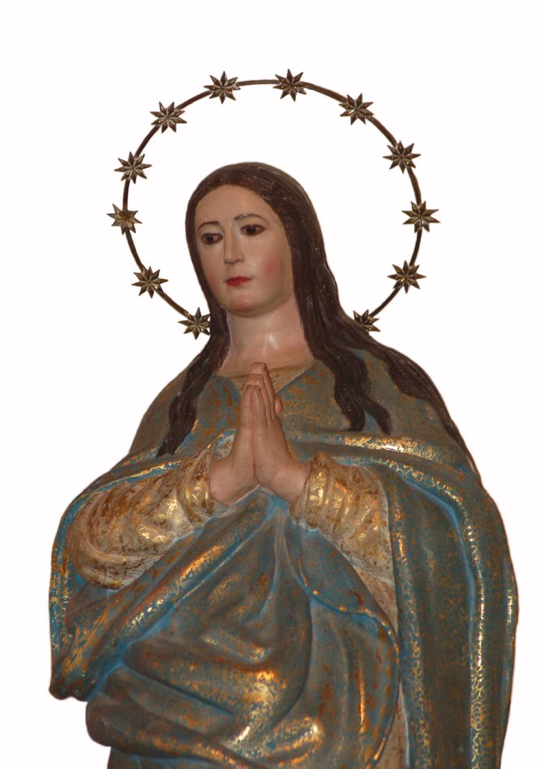
The Immaculate Conception of Mary is a gilded and polychrome wood carving. It represents the Virgin Mary in an attitude of prayer. Its appearance is reminiscent of the designs of 17th century sculpture from Granada. However, the date of its creation is unknown, as is its author. What is known is that it comes from the now disappeared convent of San Antonio that existed in the town of Gáldar.

In 1835, as a result of the confiscation laws, the State seized the convent and expelled the friars who lived there. The church’s religious equipment was left unused. The parish priest of Mogán then requested the image of the Immaculate Conception, which presided over the church of the convent, for this parish.

It arrived in this village in 1838. Nowadays, its appearance is not in keeping with its age, due to a thorough restoration carried out in 1967.

6. Holy Christ

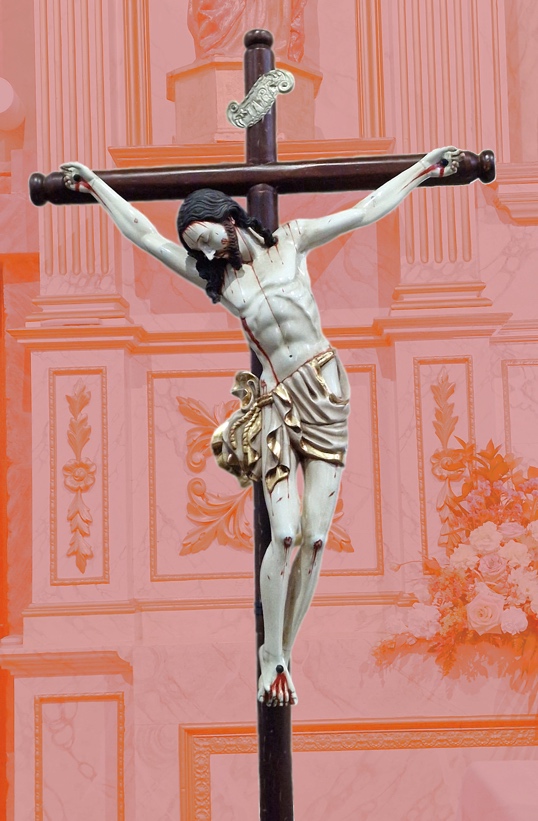
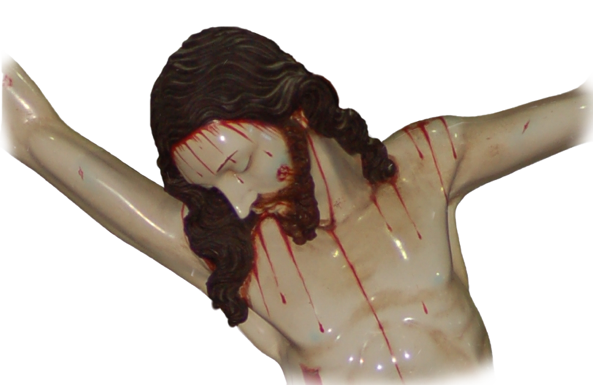
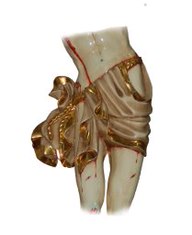
Next to the altar there is a small image of Jesus crucified. It is a polychrome wood carving made recently in Ecuador, in the workshop of the artisan Ricardo Villalva.

It imitates models of the American baroque style. It was acquired by a priest son of this town, who later donated it to this parish.

7. Baptismal Battery

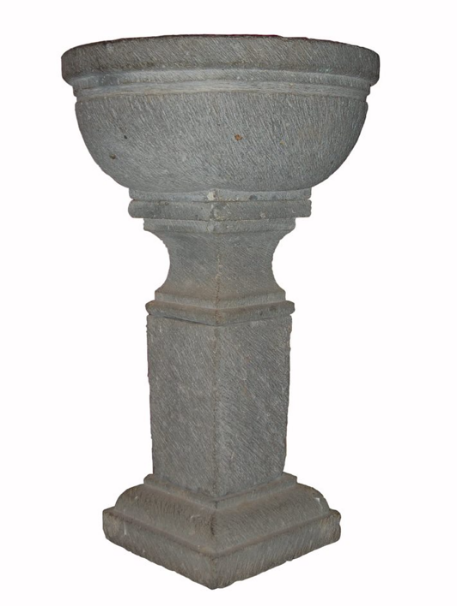
The baptismal font is located near the altar. It is a work of craftsmanship carved in basalt stone. It is used to contain the water used in baptism ceremonies.

Due to the simplicity of its design and type of stone, it reminds us of others made at the beginning of the 19th century.

For this reason, it is very likely that it is the same one that was placed when the Parish was founded in 1814.

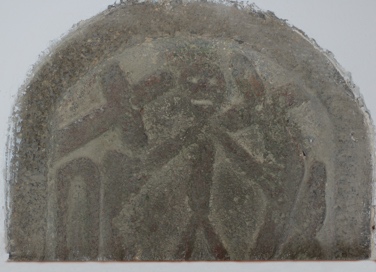
8. Stone Bas-Reliefs

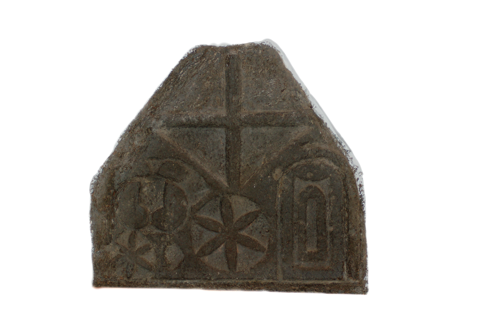
Two stone plaques attached to the walls will attract our attention. One is next to the north side door. It is mitral in shape and has a cross, stars and elements that are difficult to identify carved in relief.

Next to the main door is another, with three straight sides and an arched top. It contains a very schematic human figure and crosses, among other elements.

In both cases they are roughly carved reliefs, so we assume that they are the work of stonemasons with no artistic training. They were part of the holy water basins that were located next to the doors.

These basins were removed a long time ago, but these tombstones remain.

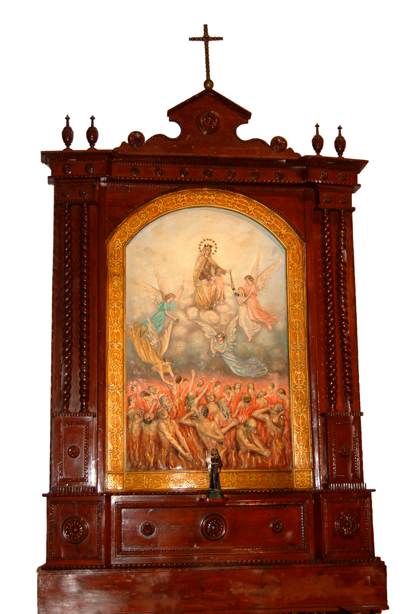
9. Altarpiece of Souls

The altarpiece of the “Ánimas del Purgatorio” (spanish for “Souls of the Purgatory”) could be said to be a version of the Baroque altarpieces with Solomonic columns. 

It has the same decorative elements as the Calvary altarpiece; therefore, both must have been made by the same craftsman and around the same time, approximately in the mid-20th century. It shelters the painting of the souls.

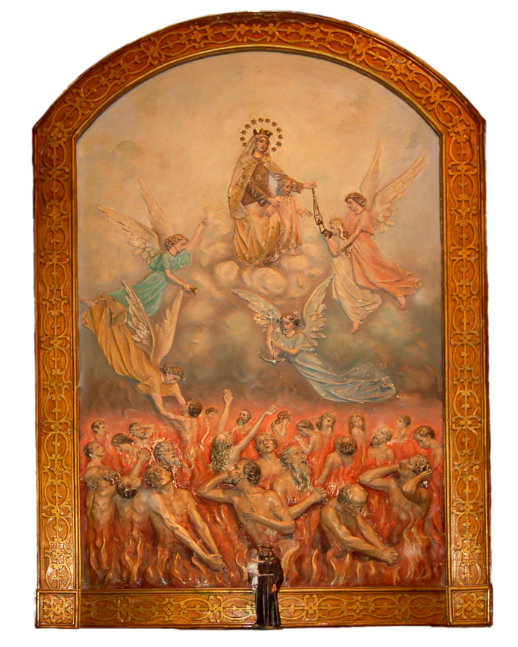
In this case, it is a relief in hardened plaster made in series. It is presided over by the Virgin of Mount Carmel, who is at the top centre. Below are the souls trying to get purified, men and women, amidst symbolic flames. 

Between them and the Virgin, several angels release the souls that have already been purified. One of them carries an anchor, a symbol of hope. Another appears to be holding a hyssop with which he pours water over purgatory.

10. Portraits of the Founders of the Church of San Antonio

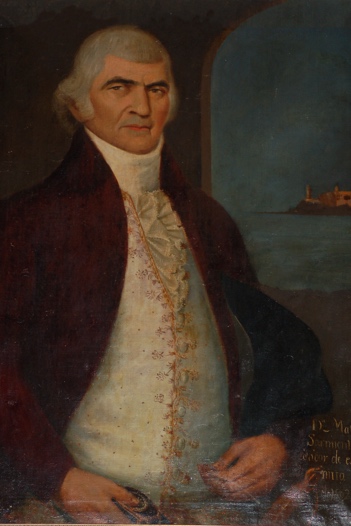
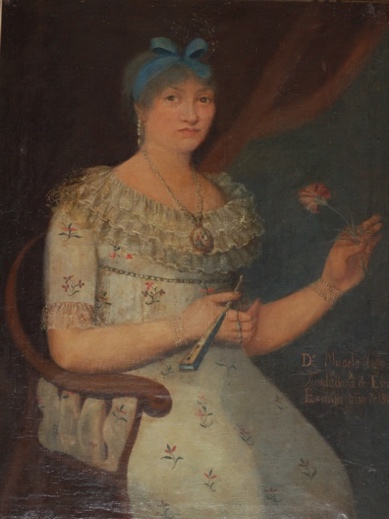
Next to the main door are the portraits of the founders of this church, Matías Sarmiento and his wife Micaela Coto.

They were painted in Havana in 1802 by a painter called Vicente Escobar.

Sarmiento sent them to this village as a reminder of his benevolent gesture as a sponsor of the construction of the church.

11. Sponsorship and Collaboration in the production of this cultural walk

This cultural initiative of a historical-artistic nature has been carried out in view of the manifest interest of the Town Hall of Mogán and the collaboration of the Association of Culture and Heritage of the Canary Islands (CUPACAN).